
By the end of day one, we could play Command 2120. We spent the next three days making it a game we wanted to keep playing.
One developer took this browser-based real-time strategy game through a four-day build with AI. The starting point was a roughly 10,000-character SPEC.md covering the game mechanics, units, buildings, multiplayer, and engine design. Some of its most useful lines dealt with surprisingly small questions. If two mines sit on the same ore deposit, for example, are they drawing from the same reserve?
That question had a written answer before there was a game. Whether managing those mines would be fun was something we could only find out by playing.
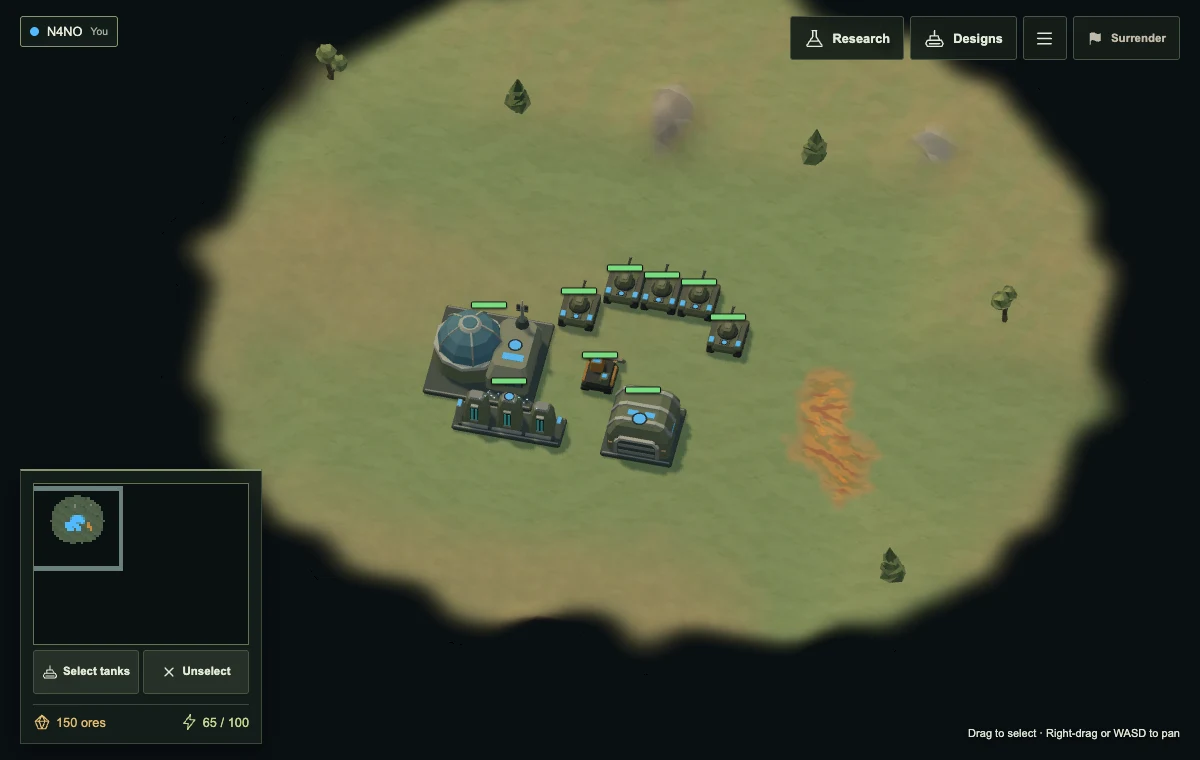
What went into the spec before the first playable build
The design called for matches with up to four players. Each player would start with a single construction vehicle and some ore. From there, they would need to establish power, mine resources, and build a vehicle factory. A factory could produce one vehicle at a time. A second factory would increase production, provided the player could keep it supplied.
The ore deposit is a good example of the level of detail we gave the AI. Here's an excerpt from the original spec, edited for clarity:
A deposit can span several connected map tiles. Each tile can hold one mine, and all mines on the deposit draw from the same ore reserve. When only 10% remains, the deposit changes appearance. Once it is empty, the deposit disappears and its mines stop producing.
That paragraph settles decisions across several parts of the game. The map determines where a mine can go. The simulation tracks a shared reserve. The renderer gives the player a visible warning before production stops. It also gives the developer something concrete to check: put two mines on one deposit and see whether they exhaust it together.
This is what a useful specification does in our AI software factory. It gives an agent enough detail to implement a feature and gives the engineer a way to tell whether the result matches the design.
How we specified the multiplayer engine
The spec assigned the game simulation to a stateful Rust server using Bevy and the 3D presentation to a TypeScript browser client using Three.js. It called for binary WebSocket messages defined with Protobuf, with corresponding types on both sides.
One decision illustrates why we went into that detail. The server was designed to update the simulation 20 times per second. Sending the position of every moving object for every animation frame would tie the browser's presentation to those updates. Instead, the spec called for the server to communicate an event (one vehicle fired at another and scored a hit) so the browser could animate the action smoothly between updates.
Specifying that boundary up front gave the AI a consistent answer to an engineering question that would otherwise recur throughout the build: which decisions belong to the server, and which belong to the browser?
Day one gave us something to play. Days two through four gave us something to judge.
Once the game was playable, the developer could evaluate a different set of questions. Consider placing a vehicle factory. The spec says it occupies four map tiles and that the placement preview should be green on valid ground and red where construction is blocked. Those are straightforward rules to verify. But can a new player tell why a location is blocked? Can they find a valid spot without fighting the controls? A correct implementation still leaves room for a frustrating experience.
That distinction shaped the four days. The first day produced a playable version. The following three went into usability and how the game felt to play. The written rules gave us a way to judge correctness. Playing gave us a way to judge the rules themselves.
One issue we fixed was jerky vehicle movement when network updates arrived unevenly. The browser began using a shared playback clock based on the server's simulation ticks. We added a regression test that checks whether a vehicle keeps moving steadily when updates arrive in bursts.
What this means for an MVP built with AI
The useful measure from Command 2120 is time to first meaningful feedback. One developer had a playable build on day one, leaving most of the four-day effort for decisions that were easier to make with the game running. We didn't build a second version using a conventional process, so a claim about months saved would be a guess.
The same principle applies to a business MVP. If you're commissioning a customer portal, an early milestone might be the first time a customer can sign in, find an order, and understand its status without calling your team. A detailed spec helps the engineer and the AI get that workflow into your hands. Trying it tells you what the next stage should change.
Have an MVP in mind? Tell us what someone should be able to do in the first working version. Our team will review your brief and send you a proposed scope, budget range, and estimated timeline within 24 hours. Get a project estimate from N4NO